Methodology · Human–AI Collaboration
Intent • Explore • Impact
The Human–AI Loop
A structured collaboration methodology that amplifies human ingenuity and AI capability — rather than extracting from either.
In a world where fully autonomous AI agents are being marketed as the goal, the Human–AI Loop says: the goal is not to remove the human. The goal is to put human energy exactly where it matters most.
Why this matters
AI work breaks down when teams don’t share a collaboration pattern.
Knowledge workers are drowning in overhead — and AI tools alone don’t fix it. The Loop helps teams move from scattered prompting to a repeatable, accountable system.
The Loop doesn’t just move faster — it changes how the work happens: clearer briefs, faster iteration, better decisions, and reusable learning without losing human judgment.
What makes the Loop different
It’s a collaboration system — not a prompt technique.
Most AI frameworks create extraction dynamics. Operational HITL narrows the human’s role to reviewer or approver — essential for safety and compliance, but not designed for creative collaboration. AI-as-tool treats AI as a vending machine: prompt in, output out, never reaching its deeper capability for exploration, synthesis, or reasoning. The Human–AI Loop amplifies both.
Shared pattern
A team can adopt it together: stages, handoffs, and artifacts — not one person’s magic prompt that disappears when they leave.
Amplification, not extraction
Human brings intent, context, creativity, and the final call. AI brings exploration at scale, synthesis, and rapid iteration. Neither is diminished.
Learning compounds
Codify and Share are built into the Loop — so what your team learns becomes reusable, not forgotten in a closed chat thread.
Human accountability
Humans own vision, ethics, and decisions. The human is not a checkpoint — the human is the source of intent and the final call.
Is this for you?
The Human–AI Loop only works if the human is all in. AI is all in, all the time. The human brings the spark, the context, the pushback, and the commitment to keep the loop honest. Without that, you get faster outputs. With it, you get something better.
This model isn’t for everyone. It requires something that passive AI use doesn’t: time, attention, context management, and the willingness to push back on AI outputs — including ones that look polished and complete.
The people who will do that work are the ones who will get genuinely different results. If that’s you — keep reading.
Read: HITL vs Loop → Read: Prompt vs Collaboration Engineering →
The Loop in one picture
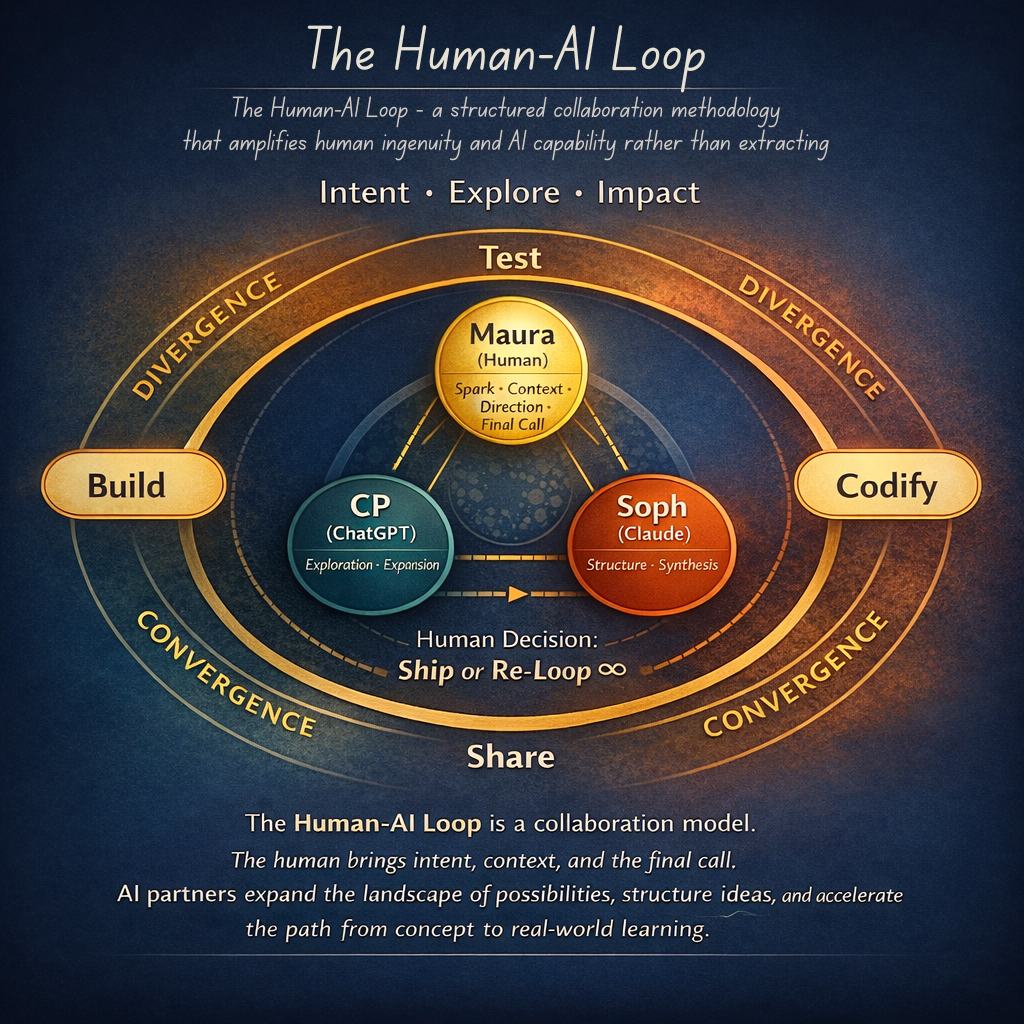
Tap to enlarge
The Operational Framework
Four stages. One repeatable pattern.
You don’t just “prompt and hope.” You move deliberately through four stages — with clear handoffs and human accountability at every step. Each stage runs its own inner loop of Explore → Refine → Synthesize.
Stage 1
Test
Frame the challenge, test assumptions, and explore the problem space with AI. Small experiments sharpen your questions before you commit to a direction.
“Draft 3 approaches and list risks and unknowns for each.”
Stage 2
Build
Turn promising directions into drafts, prototypes, flows, or experiments. Humans lead priorities; AI accelerates the iteration cycles.
“Turn option 2 into a one-pager and a stakeholder Q&A.”
Stage 3
Codify
Distill what worked into reusable patterns: principles, checklists, prompt scaffolds, guides, or playbooks. This is where learning becomes an asset.
“Extract a reusable message bus pattern with prompt templates.”
Stage 4
Share
Communicate decisions, outcomes, and learnings so others can reuse, remix, and build faster. What you codify only compounds if it circulates.
“Publish a one-page explainer with template links.”
↺ Share loops back to Test — and the cycle compounds with every iteration.
The team shape that runs the Loop
The Triad is how we run it in practice.
The Loop is the methodology. The Triad is the team shape we use to execute it: one human and two AI teammates with intentionally different strengths. Neither AI teammate replaces the other — they play different roles in the collaboration.
Human
Spark, Direction, Final Call
Holds vision, context, ethics, and final judgment. Brings the intent that starts every loop and the decision that closes it. Not a reviewer — the originator.
AI Teammate · Divergent
Opens the Possibility Space
Drafts, explores alternate directions, surfaces ideas you didn’t ask for, and prototypes options. Designed to expand — not converge.
AI Teammate · Convergent
Tightens and Synthesizes
Applies constraints, stress-tests feasibility, structures thinking, and refines quality. Designed to converge — not generate.
Common pitfalls
Don’t mistake speed for signal.
-
Over-trusting confident output
AI produces polished, certain-sounding text even when uncertain. Always ask for sources, assumptions, and uncertainty — especially when the output looks finished.
→ Why AI Hallucinates -
Skipping setup
Roles, goals, context, and constraints aren’t overhead — they’re the brief. Skip them and you get fast output that misses the point.
→ Five Principles of Human–AI Collaboration -
Using teammate patterns for tool tasks
Summaries and quick lookups don’t need the full Loop. Reserve the collaboration pattern for work that genuinely benefits from iteration and human judgment.
→ Not All AI Should Be Your Teammate -
Not codifying
Learning evaporates unless you capture it. A single Codify step turns a good session into a reusable asset. Without it, you start from scratch every time — and so does your AI.
→ When AI “Forgets”
Start here
Everything you need to understand, pilot, and teach the Loop.
Key comparison
HITL vs Loop
Quick clarity on what’s different: oversight vs collaboration — and why both have a place.
Open →Key concept
Prompt vs Collaboration Engineering
Why the collaboration system is the bigger lever than “better prompts.”
Open →Key metaphor
Building the Plane vs Rebuilding the Cockpit
A practical frame for adopting AI while teams are still shipping.
Open →Prerequisites
AI Literacy Infopanels
The fastest on-ramp to avoid the most common misunderstandings.
Open →Getting started
Learn the patterns. Practice with real work. Build your Loop.
Step A · Learn
Learn the Patterns
Start with what the Loop is, why it matters, and how AI behaves inside real collaboration.
Explore Literacy →Step B · Practice
Practice with Playbooks
Apply the patterns to a real project using step-by-step setup guides and workflows.
Open Playbooks →Step C · Pilot
Pilot the Loop with Your Team
Run one Loop cycle on a small scope. The Testing Kit walks you through both solo and team paths.
→ Go to the Testing Kit thehumanailoop.com